
Understanding Autism, ADHD, and OCD
Not everyone who struggles knows why.
Sometimes you’ve adapted so well that what you’re experiencing doesn’t look obvious from the outside.
Sometimes you’ve been told things about yourself that never quite fit.
Autism, ADHD, and OCD can each shape how your system thinks, feels, and responds to the world, and they often overlap in ways that can make it hard to tell where one ends and another begins.
This page is here to help you understand these patterns in real, human terms, not just diagnostic language.
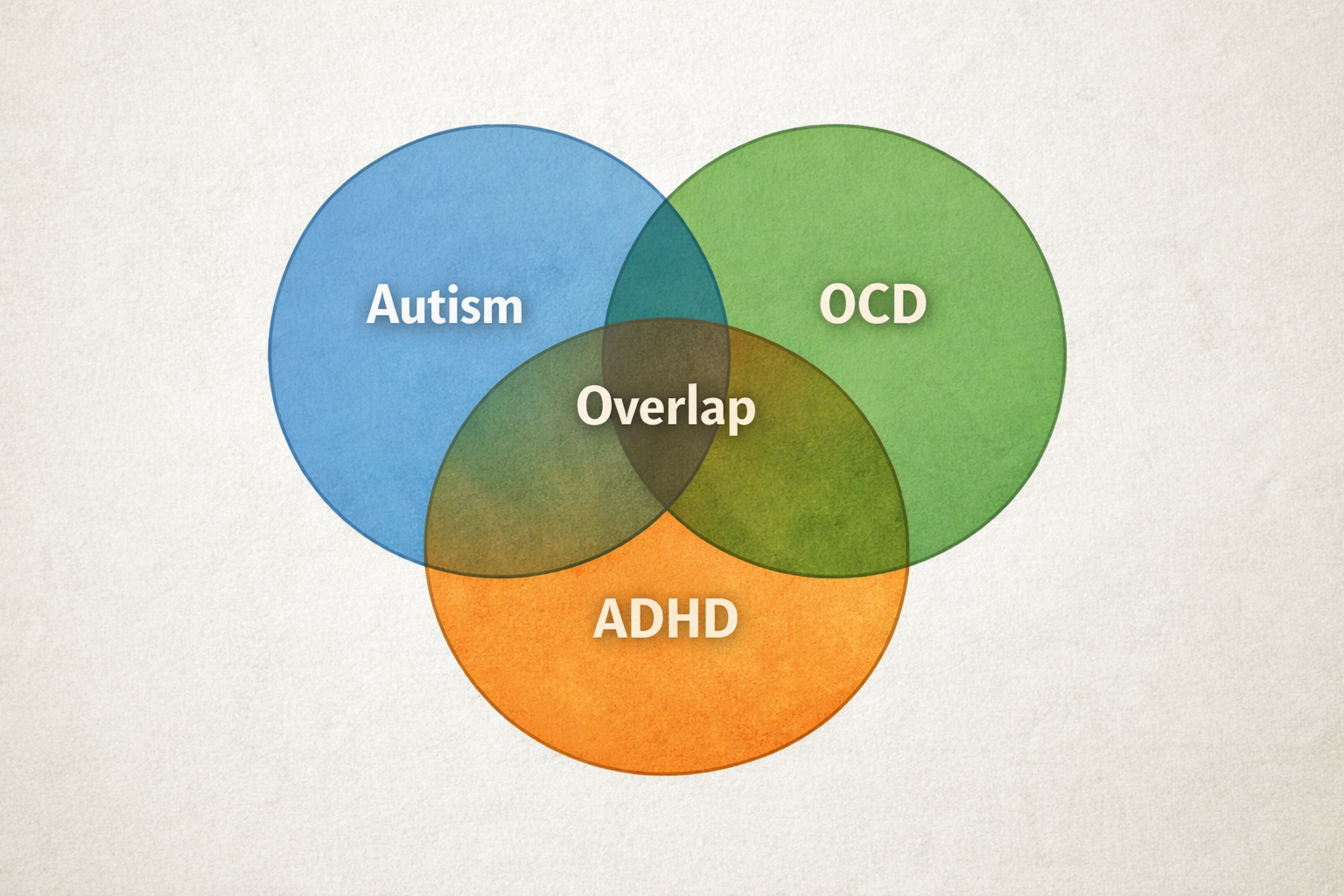
If you’re noticing yourself in more than one of these patterns, you’re not alone.
Many people benefit from a thoughtful, individualized assessment to better understand how these experiences fit together.
Autism
Autism is not just one thing. It’s a pattern of how your brain processes:
Information
Relationships
Sensory input
Predictability and change
Clinically, autism is assessed across several domains. Here’s what that actually looks like in everyday life:
1. Social Understanding & Communication
Not a lack of interest, but a difference in how connection works.
You might:
Miss subtle social cues, read them differently, or find yourself anxiously trying to figure out what to say and how to say it so you’re understood or accepted
Overanalyze conversations after they happen, replaying what you said, how it might have been perceived, and whether you said too much, too little, or the wrong thing
Prefer direct, clear communication, and may feel confused, frustrated, or anxious when things are implied, indirect, or left open to interpretation
Feel like you learned social interaction “manually,” developing internal rules or algorithms for how to respond, what to say, and how to navigate different situations
2. Back-and-Forth Interaction
Conversations can feel effortful rather than automatic.
You might:
Not always know when it’s your turn to speak, leading to interrupting, hesitating too long, or missing the moment to respond
Struggle to stay engaged in small talk, especially when the conversation feels surface-level, unstructured, or lacking clear direction
Feel drained after social interaction, even when it goes well, because of the effort it takes to track, respond, and stay attuned
Either hold back and say very little, or, when you feel comfortable, speak at length and later wonder if you shared too much
3. Relationships
Connection may feel confusing or inconsistent.
You might:
Want relationships but aren’t always sure how to maintain them, especially when it comes to initiating contact, keeping things going, or knowing what’s expected over time
Feel different even in close relationships, like there’s a gap between your experience and others that’s hard to explain or bridge
Prefer fewer, deeper connections, and may find surface-level or high-volume social interaction draining or unfulfilling
Feel unsure what others expect from you in relationships, including how often to reach out, how to respond, or whether you’re doing it “right”
4. Repetitive Patterns or Routines
Your system may rely on consistency to feel stable.
You might:
Like predictable routines, and may rely on them to feel grounded, organized, or able to move through your day
Feel thrown off by unexpected changes, even small ones, and may need extra time to adjust or regain a sense of stability
Have difficulty with transitions, even between expected activities, and may feel resistance or stress when shifting from one task, place, or mindset to another
Repeat certain behaviors, thoughts, or habits, especially when they help you feel more in control, soothed, or prepared
Feel better when things are structured, clear, and planned out, rather than open-ended or uncertain
Repeat certain behaviors, thoughts, or habits, especially when they help you feel more in control, reduce uncertainty, or create a sense of predictability
5. Focused or Intense Interests
Interests can be deep, absorbing, and meaningful.
You might:
Hyperfocus for long periods, becoming so absorbed in something that you lose track of time, your surroundings, or basic needs (such as eating, using the bathroom, or noticing your body’s cues)
Dive deeply into topics in a way others may not, wanting to fully understand, explore, or master something, including how and why it works beyond a surface level
Feel a strong sense of identity around your interests, where they aren’t just hobbies but central to how you understand yourself or relate to the world
Use interests as a way to regulate or ground yourself, returning to them to feel calm, focused, or more stable when things feel overwhelming (for example, getting absorbed in a favorite topic, rewatching something familiar, or focusing on an activity that helps your system settle)
6. Sensory Processing
Your nervous system may experience the world more intensely.
You might be:
Easily overwhelmed by noise, light, textures, or crowds, where environments like loud spaces, bright lighting, certain fabrics, or busy settings can feel intense or hard to filter out
Highly sensitive to subtle sensory changes, noticing shifts in sound, lighting, temperature, or physical discomfort that others may not register
Either avoid or seek certain sensations, needing to reduce input like noise or stimulation to feel okay, or craving movement, pressure, or specific textures to feel regulated
Feel exhausted from managing sensory input, especially after being in stimulating environments where you’ve had to tolerate, filter, or push through just to get through
7. Masking & Adaptation
Many people learn to hide or compensate.
You might:
Study how others behave and copy it, observing tone, facial expressions, and timing to figure out how you’re expected to act
Rehearse conversations, planning what you’ll say ahead of time or replaying interactions afterward to adjust or get it “right”
Push through discomfort to appear fine, forcing eye contact, staying in overwhelming environments, or suppressing reactions so others don’t notice
Feel exhausted or disconnected afterward, often needing time alone to recover or feeling like you weren’t fully yourself
8. Developmental Patterns
Autism is present early in life, even if it wasn’t recognized.
You might:
Remember feeling different as a child, even if you couldn’t explain why or didn’t have the language for it
Have had strong preferences, sensitivities, or routines, where certain ways of doing things felt important, comforting, or necessary
Have been labeled “shy,” “intense,” or “particular,” often without others fully understanding what was happening internally
Have learned to adapt over time, developing ways to fit in, cope, or navigate environments that didn’t quite match how your system works
Autism is a way your system organizes and experiences the world, shaping how you process information, relate to others, respond to sensory input, and create patterns of predictability and meaning.
ADHD
ADHD shapes how your system regulates attention, motivation, energy, and follow-through.
It affects not just what you do, but how you start, sustain, and shift between tasks, thoughts, and emotions.
Attention & Focus
Have difficulty directing attention consistently, finding it hard to engage with tasks that don’t naturally hold your interest
Have difficulty reading or consuming information in a steady way, often skimming, rereading, or needing to go back because your attention drifted
Become deeply absorbed in things that do capture your attention, sometimes to the point of losing track of time or everything else around you
Shift attention quickly, moving between thoughts, tasks, or stimuli, even when you’re trying to stay focused
Struggle to sustain attention over time, especially for tasks that feel repetitive, slow, or unengaging
Prefer to consume information at a faster pace, such as speeding up podcasts or videos, in order to stay engaged and maintain attention
Executive Functioning
Have difficulty organizing, prioritizing, or breaking tasks into manageable steps, even when you understand what needs to be done
Struggle with time awareness, underestimating how long things take, or losing track of time altogether
Forget tasks, plans, or details, not because they don’t matter, but because they are hard to hold in active awareness
Feel overwhelmed by starting or completing tasks, especially when they involve multiple steps or unclear structure
Emotional Regulation
Experience emotions intensely, with reactions that can feel immediate, strong, and difficult to modulate
Have difficulty shifting out of emotional states, where frustration, anxiety, or overwhelm can linger longer than expected
React quickly in the moment and later reflect or reassess once there is more space or clarity
Feel easily overwhelmed when multiple demands, emotions, or inputs are happening at once
Internal Restlessness
Experience a constant stream of thoughts, ideas, or internal dialogue that can be hard to slow down
Feel mentally or physically restless, even during times when you’re trying to relax or be still
Seek stimulation or activity to feel engaged, focused, or settled
Become bored quickly when something doesn’t hold your attention, leading to a need for change or novelty
Need to do more than one thing at once to stay engaged, such as listening while moving, fidgeting, or multitasking to maintain focus
Motivation & Follow-Through
Know what needs to be done but have difficulty initiating action, even when something is important to you
Rely on urgency, pressure, or deadlines to activate focus and follow-through
Start tasks with intention but have difficulty completing them, especially when interest fades or obstacles arise
Experience frustration or self-criticism when effort doesn’t translate into consistent action
A Note on Experience
ADHD reflects how your system initiates, sustains, and shifts attention, action, and emotion.
It shapes how you engage with tasks, respond to demands, and move between focus, motivation, and follow-through, often in ways that feel inconsistent, effortful, or context-dependent.
OCD
OCD shapes how your system responds to intrusive thoughts, uncertainty, and distress.
It often involves a pattern of:
Thoughts that feel urgent or hard to ignore
A need to resolve, neutralize, or make sense of them
Repeated attempts to find relief or certainty
Intrusive Thoughts
Experience thoughts that feel unwanted, distressing, or out of character, often appearing suddenly and sticking longer than expected
Get caught on “what if” scenarios, imagining possibilities that feel important to figure out or resolve
Have thoughts that create doubt, even about things you would normally feel certain about
Feel disturbed by the content of your thoughts, especially when they don’t align with who you believe yourself to be
Urgency & Anxiety
Feel a strong need to resolve a thought or feeling, as if something is unfinished, unclear, or not quite right
Experience a sense of urgency around needing answers, certainty, or reassurance
Have difficulty letting thoughts pass, with your attention repeatedly pulled back to the same concern
Feel increasing anxiety or discomfort the longer something feels unresolved
Compulsions (External or Internal)
Engage in behaviors or mental actions to reduce distress, such as checking, repeating, reviewing, or seeking reassurance from others
Mentally replay situations, conversations, or decisions to try to gain clarity or certainty
Avoid situations, people, or decisions that might trigger uncertainty or intrusive thoughts
Try to neutralize or counteract thoughts with other thoughts, reasoning, or internal rules
The OCD Cycle
Experience temporary relief after taking action to reduce distress, followed by the return of doubt or discomfort
Find yourself repeating the same thought or behavior patterns, even when you recognize them
Spend significant time and energy trying to feel certain, resolved, or “okay”
Feel stuck in loops of thinking and responding that are difficult to step out of
A Note on Experience
OCD reflects how your system tries to create certainty, safety, and resolution in response to distressing thoughts and internal discomfort.
It shapes how you relate to uncertainty, how long thoughts stay active, and how your system attempts to resolve or quiet them.
Next Step
You don’t have to figure this out on your own.
If you’re wondering how these patterns show up for you, we can talk through what might be helpful.